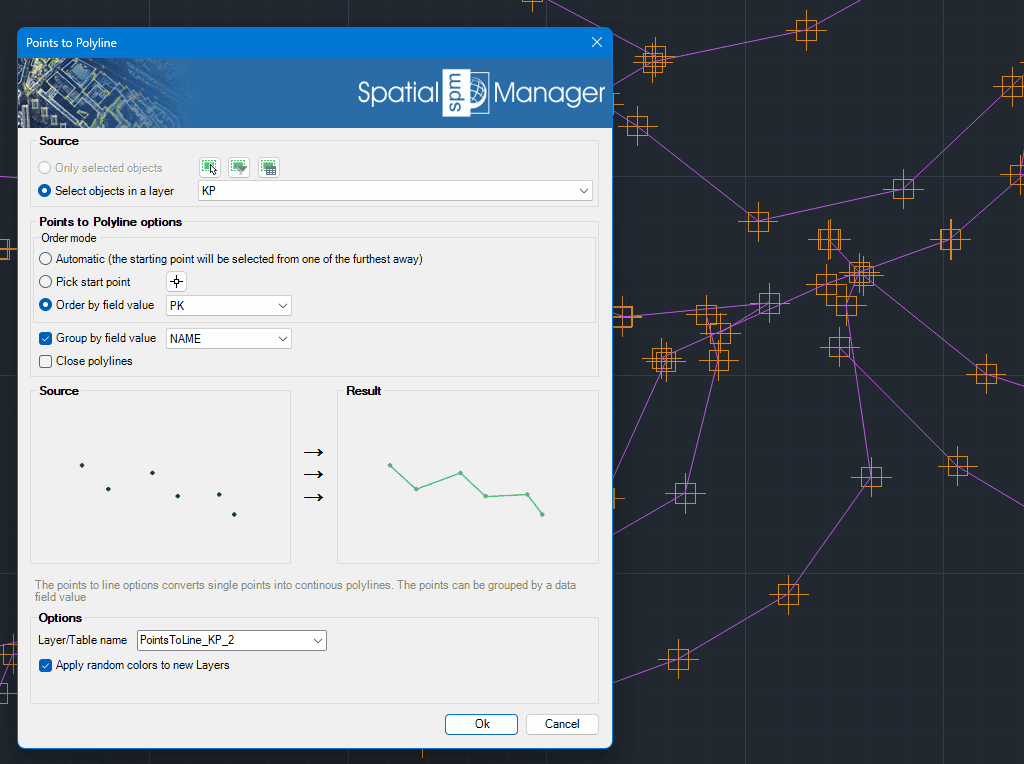
These tools enable advanced spatial operations such as simplifying shapes, generating polygons from point sets, joining or splitting elements, and converting between geometry types.
A powerful set of tools for editing and transforming polylines. Whether you need to compound new lines from anothers, convert between 2D and 3D polylines, reduce complexity using simplification, or create new linear geometries from points, these tools will help your workflow
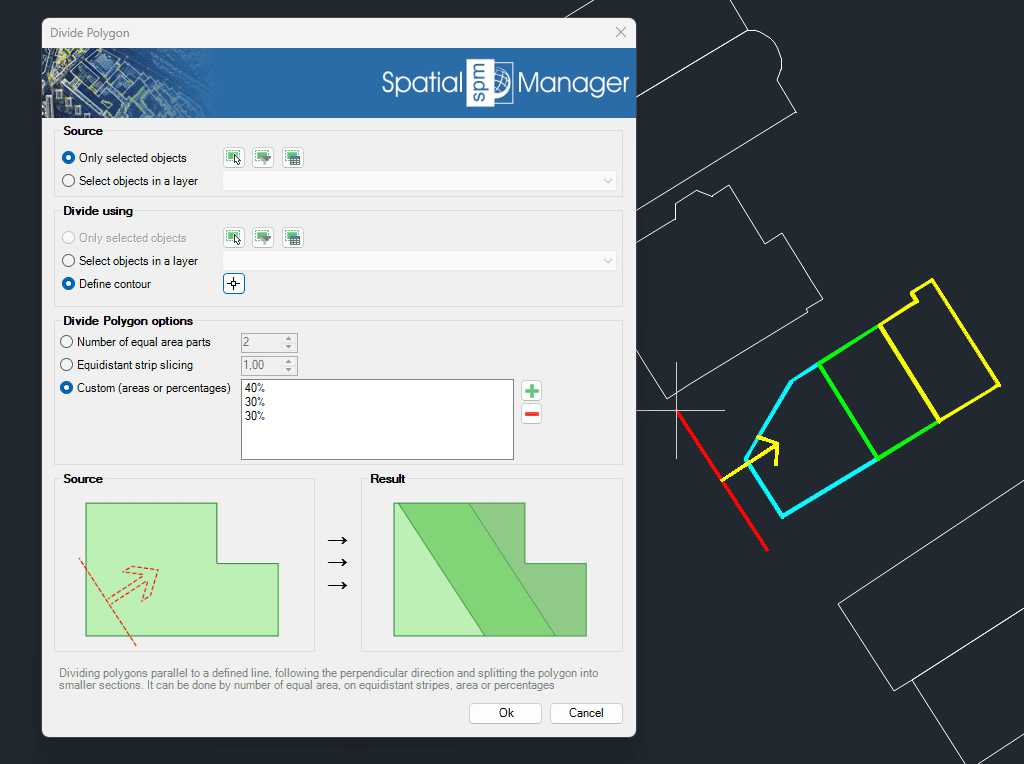
A set of polygon tools designed to simplify and enhance your spatial editing tasks. Dividing polygons into smaller sections, generating polygons from point sets, merging adjacent polygons, or creating polygons from intersecting lines
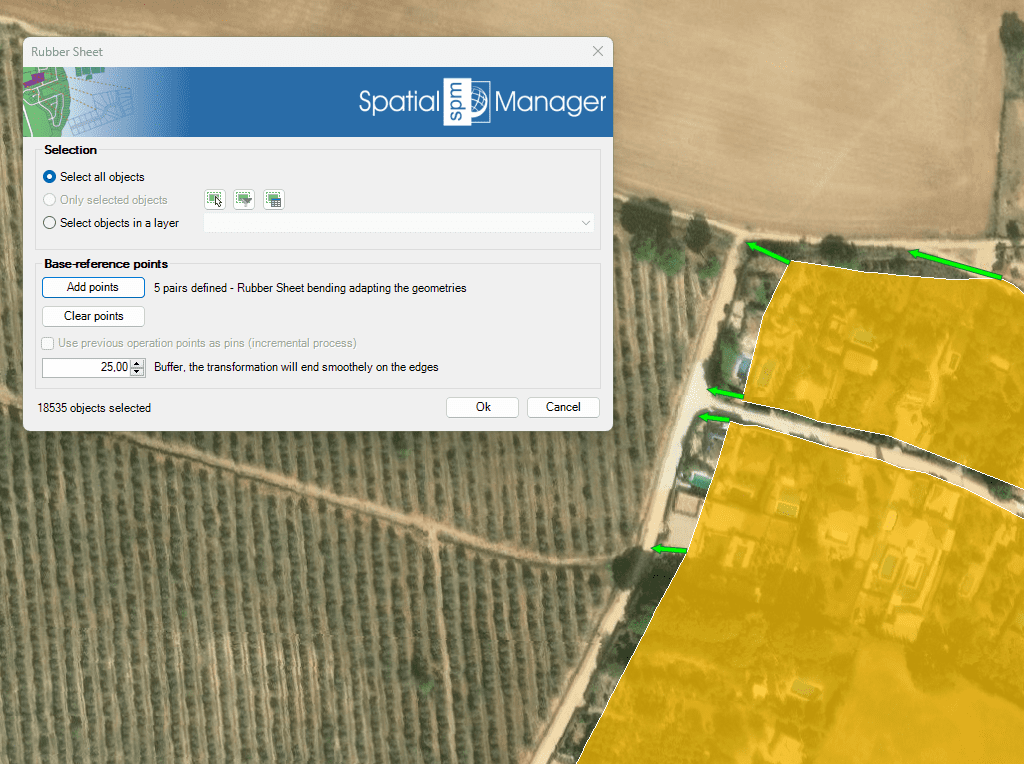
A wide range of functions to edit, reshape, and analyze spatial geometries. From aligning datasets using Rubber Sheet, cutting or trimming features with Break and Trim, to generating new geometries such as Convex Hull, Envelope, or Triangulation. Additional capabilities like Simplify reduce complexity in shapes or Vertex extraction are available
Generates polygons (closed polylines) by sequentially joining the individual points that define their perimeter. Useful for rebuilding area objects from boundary point sets (parcels, enclosures, plots, etc.). Points may be... more
Reduces the number of vertices in polylines or polygons to simplify their geometry, optimizing complexity while preserving the overall shape. This function improves performance and visualization of spatial data by... more
Generates an envelope or bounding box for the selected geometries, representing the smallest rectangle that completely contains each object. This operation is commonly used to generalize shapes, define spatial extents,... more
Converts individual points into connected polylines by automatically following their original sequence or by ordering them according to a specified attribute. This functionality is especially useful for creating linear elements... more